

agent-skills
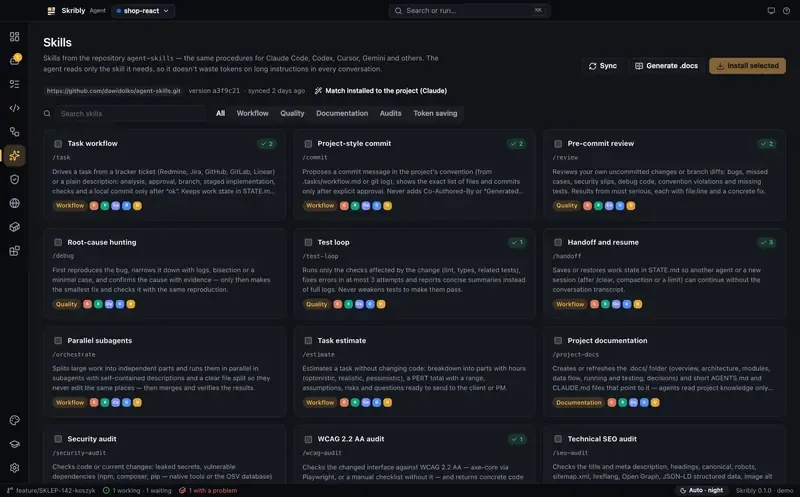
agent-skills is a library of short, tested procedures (“skills”) for AI coding agents, plus a zero-dependency installer that puts them where each agent looks. It supports Claude Code, Codex CLI, Cursor, Gemini CLI, OpenCode, Windsurf and GitHub Copilot.
Skills cover the whole loop: pick up a Redmine, Jira, GitHub, GitLab, Linear or Skribly Tracker issue, plan, branch, implement in stages, test, review, audit and commit. They also cover the specialist jobs around it: Core Web Vitals, load tests, safe migrations, Docker, CI, dependency upgrades, translations and release notes.
Principles
Section titled “Principles”- Scripts do the mechanical work. Small Node scripts hand the model a few lines instead of megabytes: a 455 KB Lighthouse report becomes 754 bytes, a 27 KB test log 86 bytes.
- Every risky step waits for your OK. Commits, comments on tracker issues, screenshots and long test runs are proposed, not done silently.
- Adapts to each project. The
projectskill detects the stack, the commands and the commit conventions into.skribly/project.json, and every skill reads that profile first. Values you set by hand are never overwritten. - Learns from the work. At the end of
task,test-loop,reviewanddebugthe agent proposes one confirmed lesson; with your OK,learnkeeps it in.skribly/lessons.mdfor the next run. Lessons that look like secrets are refused. - Commits look like yours. Messages follow the project’s convention, and no skill adds a
Co-Authored-Byor “Generated with” trailer. - Standalone. It needs nothing else from Skribly and works in any repository. Skribly Agent is one optional place that uses it.
| Version | 0.2.11 (8 November 2026) |
| Skills | 29, in the shared Agent Skills format |
| Agents | 7: Claude Code, Codex CLI, Cursor, Gemini CLI, OpenCode, Windsurf, GitHub Copilot |
| Trackers | Redmine, Jira Cloud and Server/Data Center, GitHub, GitLab, Linear, Skribly Tracker |
| Requirements | git and Node.js 20 or newer |
| Runtime dependencies | None |
| Licence | MIT |
How a skill is built
Section titled “How a skill is built”Every skill is a folder skills/<name>/:
skills/<name>/ SKILL.md at most 110 lines, read when the skill runs reference/ extra detail, read only when a step needs it scripts/ Node scripts with no dependencies that do the mechanical work templates/ files the skill fills inAn agent keeps only each skill’s name and description in its context, one line per skill. The rest loads on demand.
How it saves tokens
Section titled “How it saves tokens”-
Load on demand.
SKILL.mdloads when used,reference/only when a step needs it. The 110-line limit is enforced in CI. -
Scripts instead of the model. Measured on real projects:
Task Raw input Script output Saved Lighthouse report 455,534 bytes 754 bytes 99.8% Test run log, 86 tests 27,098 bytes 86 bytes 99.7% npm audit --jsonon a 300-package app20,555 bytes 2,126 bytes 90% git log -60to learn the commit style7,415 bytes 739 bytes 90% GitHub issue with comments 8,178 bytes 1,018 bytes 88% -
Ask before expensive steps. Screenshots, Lighthouse runs and full suites need your OK.
-
Restart instead of dragging transcripts.
STATE.md(about 30 lines) holds the goal, what was done and one next step, so you can/clearafter each stage and resume, in the same or another agent. -
Working rules. The
token-saverskill gives every agent the same habits: search before reading, read line ranges, never open lock files or build output.
Read next
Section titled “Read next”- Install: user scope or project scope, updates, Windows.
- Skills catalog: every skill and when to use it.
- Supported agents: where each agent gets the skills.
- Trackers: credentials for each tracker.
- Commits without AI trailers: the three layers that keep commits yours.